 EN

Transit Between Domestic & International Terminals: Fast Airport Shuttle Solutions
Last Updated: Sunday, August 30, 2026
So you booked a domestic flight right after landing internationally in Vietnam — smart move on paper, until you realize nobody warned you the two terminals aren't actually next to each other. Sometimes they're not even in the same building. If your layover is tight, or you just don't like the idea of jogging through an airport parking lot dragging a suitcase, it's worth knowing exactly what this transfer involves before you land, not after.
Why This Catches So Many Travelers Off Guard
It's Not Actually Next Door
At Vietnam's two busiest airports, domestic and international flights leave from completely separate buildings — anywhere from a few hundred meters to over a kilometer apart. There's no indoor hallway connecting them, so no matter how you pictured the walk, you'll need a shuttle bus or a taxi to get across.
You Still Have to Go Through Immigration — Every Time
Here's the part that trips people up: even if you're connecting the same day, Vietnam doesn't have a "sterile" transfer zone between international and domestic flights. That means immigration, baggage claim, and customs first — no shortcuts — before you can even start heading toward the domestic side.
Tan Son Nhat (SGN): Getting Between T1, T2, and T3
T1 and T2: Honestly, Just Walk
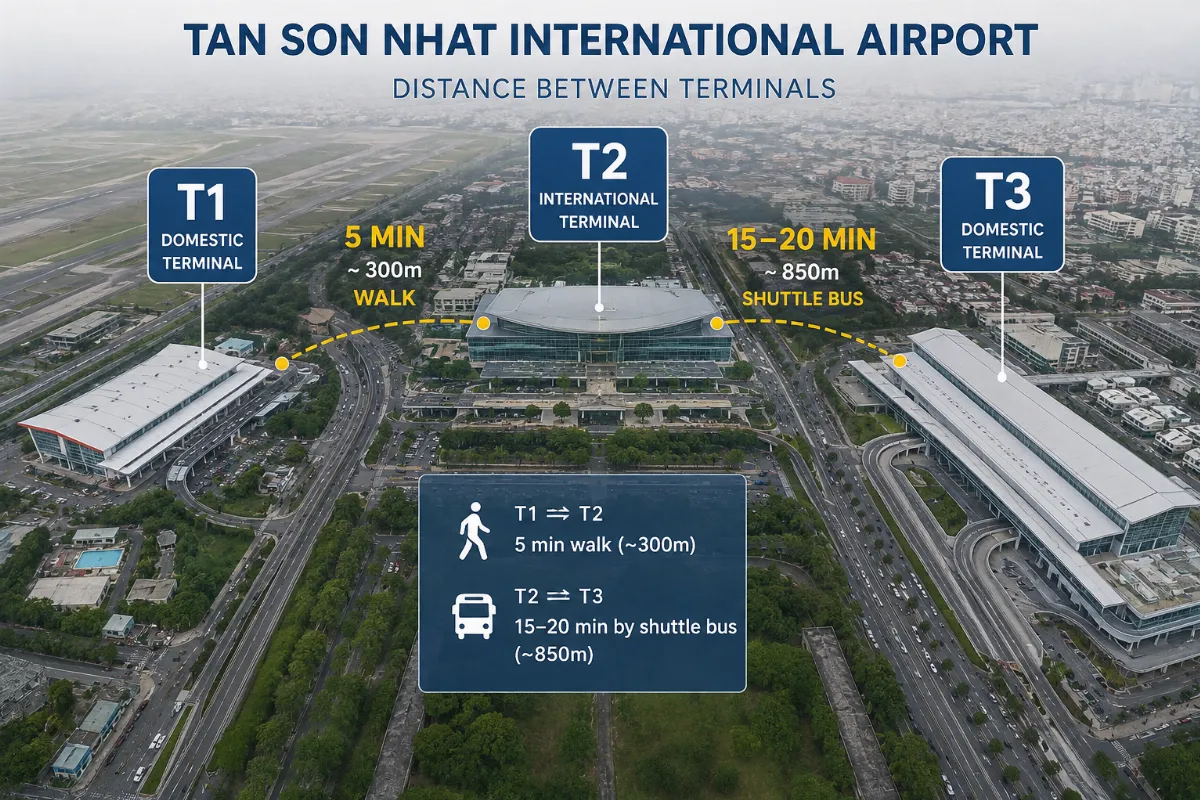
Good news here — the domestic terminal (T1) and international terminal (T2) share a ground-floor public lobby, and you can cover that distance on foot in under five minutes. No bus, no waiting around, if your connecting flight leaves from T1.
T2 and T3: You'll Need the Shuttle
Most Vietnam Airlines and VietJet domestic flights now leave from the newer T3 terminal, which sits about 3000 meters from T2 — close enough to see, far enough that you really don't want to walk it with bags. A free shuttle runs between all three terminals roughly every 20 minutes, and the ride itself takes 15 to 20 minutes depending on traffic.
Noi Bai (HAN): Moving Between T1 and T2
The Distance, and How Often the Shuttle Runs
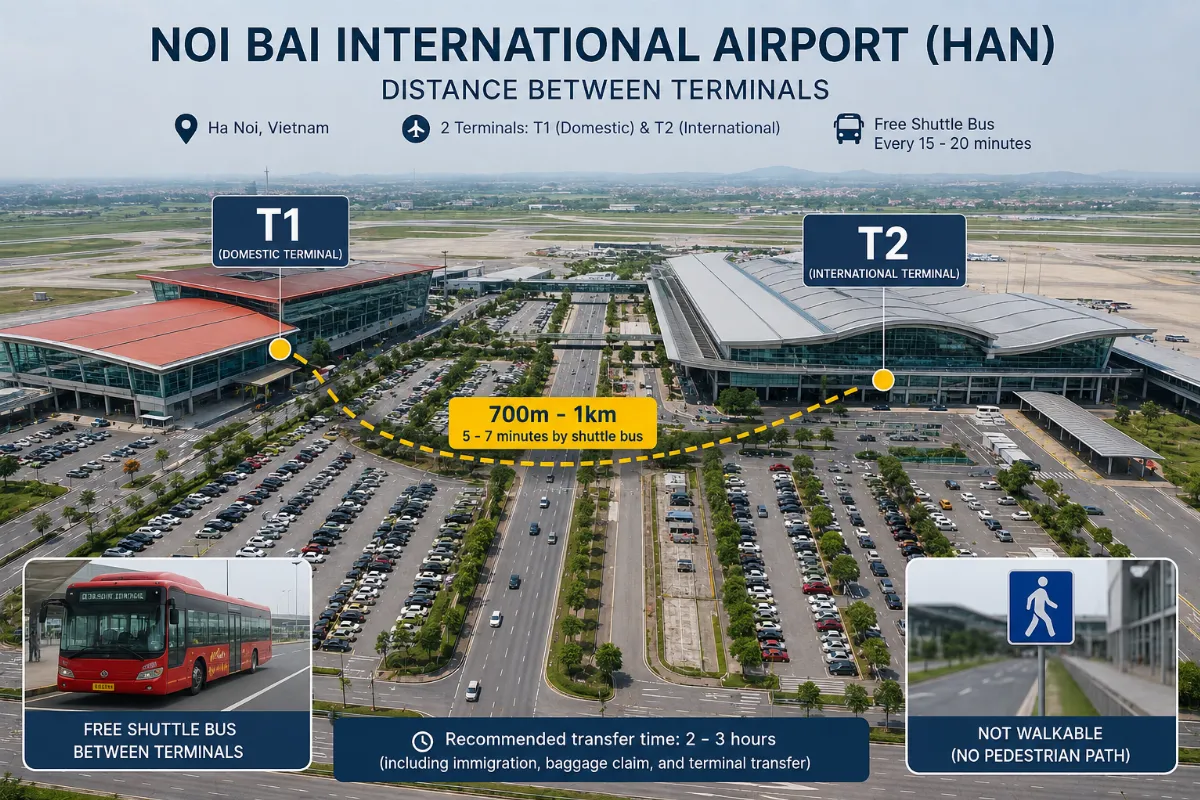
Hanoi keeps things a bit simpler — just two terminals, T1 for domestic and T2 for international. But "simpler" doesn't mean "closer": they're still separate buildings, roughly 700 meters to a kilometer apart, with nothing connecting them indoors. A free shuttle bus covers that gap every 15 to 20 minutes, running from early morning until close to midnight.
How Much Time You Should Actually Leave
The shuttle ride itself is quick — just a few minutes. But once you add disembarking, immigration, collecting your bags, and finding the right shuttle stop, a realistic buffer for an international-to-domestic connection at Noi Bai is 2 to 3 hours. Give yourself more if you're landing during a busy stretch.
If You'd Rather Not Figure This Out Yourself
If your layover is tight, or you'd just rather not learn an unfamiliar shuttle system with your luggage in tow, this is exactly what Vietnam Fast Track online is for. An agent meets you right at the arrival gate, walks you through immigration and baggage claim, and takes you straight to the correct terminal for your next flight — no guessing which door or which bus stop is the right one.
Want a slower pace between flights? VIP Fast Track adds a dedicated agent and a private lounge to wait in while your connection gets sorted out behind the scenes. Either way, if you'd genuinely rather hand the whole transfer off to someone else, you can apply priority lane and skip working it out solo.
While You're Booking, Cover the Rest Too
A tight terminal transfer is often just one piece of a longer trip. VAF's full range of Vietnam airport service options covers what comes after, too — need a ride once you're done flying for the day? You can book car pickup Vietnam. Want data ready before you even land? Book Vietnam eSIM online and it'll be waiting in your inbox.
Fast Track, car pickup, and eSIM all live under VAF's broader airport services — so one booking can genuinely cover you from your international arrival all the way to your domestic departure gate.
Key Takeaways
-
At SGN, T1 and T2 are a 5-minute walk apart — but T3 needs the shuttle (15–20 minutes).
-
At HAN, T1 and T2 are separate buildings, linked only by a free shuttle every 15–20 minutes.
-
You'll clear immigration and collect baggage even on a same-day connection — no shortcuts.
-
Give yourself at least 2–3 hours for the full transfer, more during busy arrival times.
Frequently Asked Questions (FAQ)
1. Can I just walk between the international and domestic terminals?
At SGN, yes — T1 and T2 are about a 5-minute walk. At HAN, and for SGN's T3, walking with luggage isn't really practical — take the free shuttle or a taxi instead.
2. How much buffer time should I leave for a domestic connection after landing internationally?
Give yourself at least 2–3 hours. Between immigration, baggage claim, the terminal transfer, and checking in again for your domestic flight, it adds up faster than you'd think.
3. Do I have to pay for the shuttle between terminals?
No — both SGN and HAN run free shuttle buses between their terminals, roughly every 15–20 minutes throughout the day.
4. What's genuinely the fastest way to handle a tight connection?
Book Fast Track ahead of time. An agent meets you at arrival and takes you straight through immigration to your connecting terminal — no wandering around trying to find the right shuttle stop on your own.
👉 VAF – Your trusted travel and connectivity partner in Vietnam. Book here
If you have any questions or need personalized guidance, don’t hesitate to reach out to our expert team:
-
Website: https://vietnam-airports.com/
-
Whatsapp: +84379522522
-
Hotline: +84.379.522.522
-
Email: sales@vietnam-immi.org